

Revenue-First Social Media: How Dubai Restaurants Will Measure ROI Effectively in 2025
Dubai restaurants measure social media ROI by tying bookings, sales and foot traffic to campaigns using codes, AI analytics and reservation integrations.
Social Media for Restaurants
From Likes to Ledger: Practical ROI Metrics Dubai Restaurants Must Track in 2025
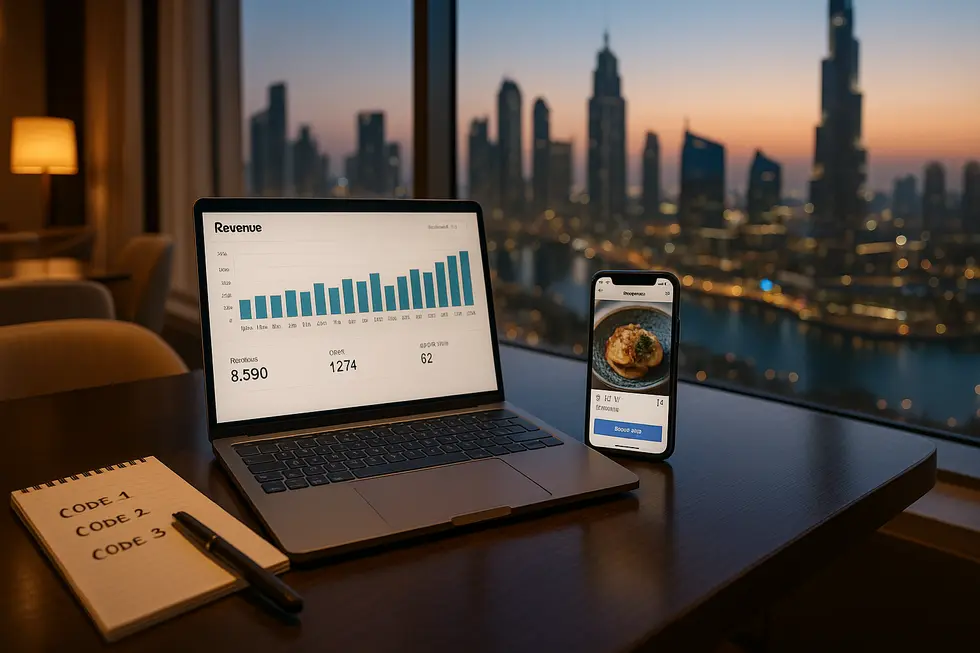 Measuring social ROI in Dubai must tie directly to revenue rather than vanity metrics. Restaurants should start with conversion events that map to real income: completed reservations, online orders with social UTMs, promo-code redemptions and tracked walk-ins. Cost per booking and revenue per booking give immediate clarity. Calculate cost per booking by dividing total campaign cost by bookings attributed to the campaign. Pair that with incremental revenue — the uplift versus baseline — to show true campaign impact.
Attribution requires operational plumbing. Embed booking buttons on social profiles, use UTM-tagged links for delivery and reservations, and assign unique promo codes for influencers. Tag POS entries or ask a simple question at the table to capture offline redemptions. Feed all touchpoints into a single CRM that receives reservation, POS and campaign metadata. Where deterministic paths break, apply modelled attribution to estimate incremental lift and avoid double-counting.
Engagement signals remain valuable as leading indicators. Profile visits, CTA clicks, story sticker taps and DM conversion rates predict bookings when tracked consistently. Short-form view metrics and watch time correlate strongly with discovery in Dubai’s short-form-first market. For creators, reward measurable outcomes: cost per booking, code redemptions and tracked link conversions rather than follower counts.
Paid efficiency metrics should sit alongside revenue metrics. Track ROAS for paid campaigns, CPA for acquisitions, and CPL for reservation leads. Run holdout tests to measure incremental lift and separate organic growth from paid effects. Daily dashboards work for paid performance; weekly reports for content signals; monthly and quarterly rollups for revenue attribution and CLV analysis.
Implement a practical calculation flow: define conversion events, attribute revenue (average check × covers), calculate total campaign costs, then compute ROI, ROAS and cost per booking. Finally, factor in lifetime value and repeat visits to capture longer-term returns. Use AI-driven models to combine multi-touch sequences when direct tracking is limited; these models help predict who will book and assign credit across touchpoints.
Start small: pilot with micro-influencers, standardize UTMs and codes, and run one A/B holdout test in 90 days to validate lift. For a concise primer on converting social engagement into bookings, see this guide on social engagement into bookings (Dubai): https://www.markus-mensch.ae/blog/social-engagement-into-bookings-dubai.
External reference: UAE restaurant trends research (2025) — https://sevenrooms.com/research/2025-UAE-restaurant-trends/
From Likes to Lunch Covers: Building a Revenue-First ROI System for Dubai Restaurants in 2025
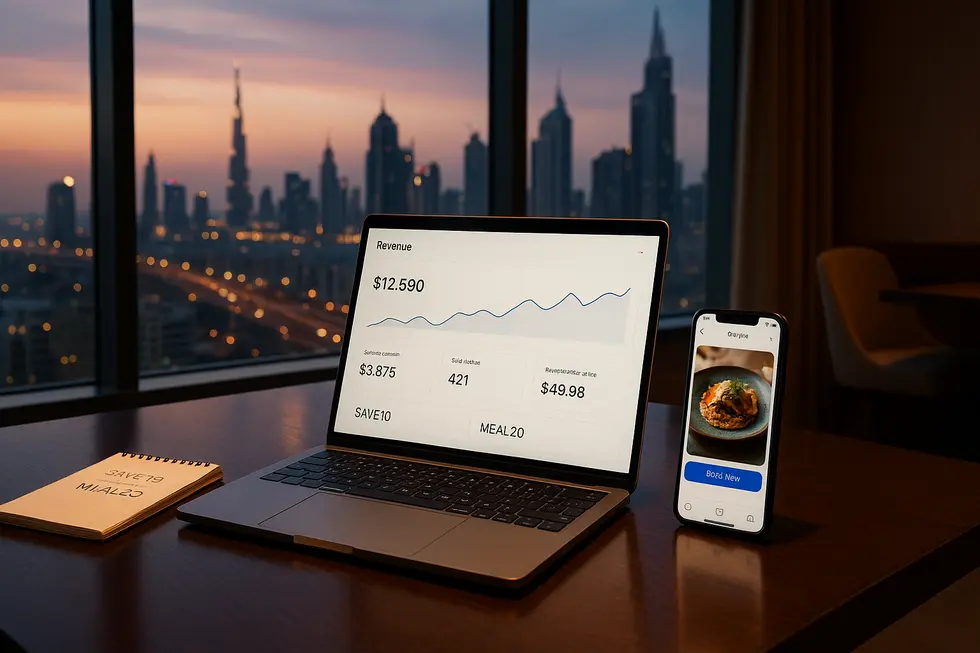 A revenue-first measurement system will separate successful Dubai restaurant social programs from the noise in 2025. Start by aligning social metrics to business outcomes: cost per booking, revenue per booking, conversion rate from a social post to a reservation, average order value and 90-day lifetime value. Those KPIs replace vanity signals and give operators an objective way to judge campaign spend. Instrumentation follows: enable in-app booking and ordering, deploy short landing flows with UTM tags and social-only promo codes, and capture first-party identifiers at the point of conversion so each reservation writes into your guest record.
Measurement must be hybrid and privacy-aware. Use rule-based attribution for operational clarity while layering probabilistic models and incrementality tests to estimate causal impact when deterministic links break. Run simple holdouts—time or geo splits—against paid and creator campaigns to measure net new covers, not just engagement lifts. Calculate true ROI by attributing incremental revenue to social after deducting media, creator and incremental operating costs; report against CPA and target return thresholds to guide scaling decisions.
The tech stack should close the loop between a social touch and revenue without naming vendors: connect booking flows to reservations, POS and CRM so each social-origin booking carries spend, visit history and contact data. Add a marketing analytics layer or CDP to join ad data, reservations and orders into cohorts that reveal CPA by channel and cohort LTV. Prioritise server-side event collection and explicit consent to maintain attribution in a privacy-first environment.
Operational governance is non-negotiable: standardise naming conventions and KPI definitions across marketing, front-of-house and revenue teams so a “booking” means the same thing everywhere. Model and report beyond the first cover; social should be judged on repeat visits and lifetime value, not a single night’s revenue. Tactically, run short-form creative A/B tests and scale assets that lower cost per booking and raise average cover spend. Pilot micro-influencers with unique booking links and control groups, then scale winning pairs of creative and placement.
Avoid two common traps: measuring reach without revenue and failing to integrate bookings with POS. Start small, test incrementally, and iterate on what clearly moves covers and spend. For an example framework and further research, see this industry study: https://sevenrooms.com/research/2025-UAE-restaurant-trends/ For practical implementation guidance, explore this resource on social-engagement-to-bookings: https://www.markus-mensch.ae/blog/social-engagement-into-bookings-dubai
From Likes to Bookings: Dubai Trends, Measurement Challenges, and Practical ROI Playbook for 2025
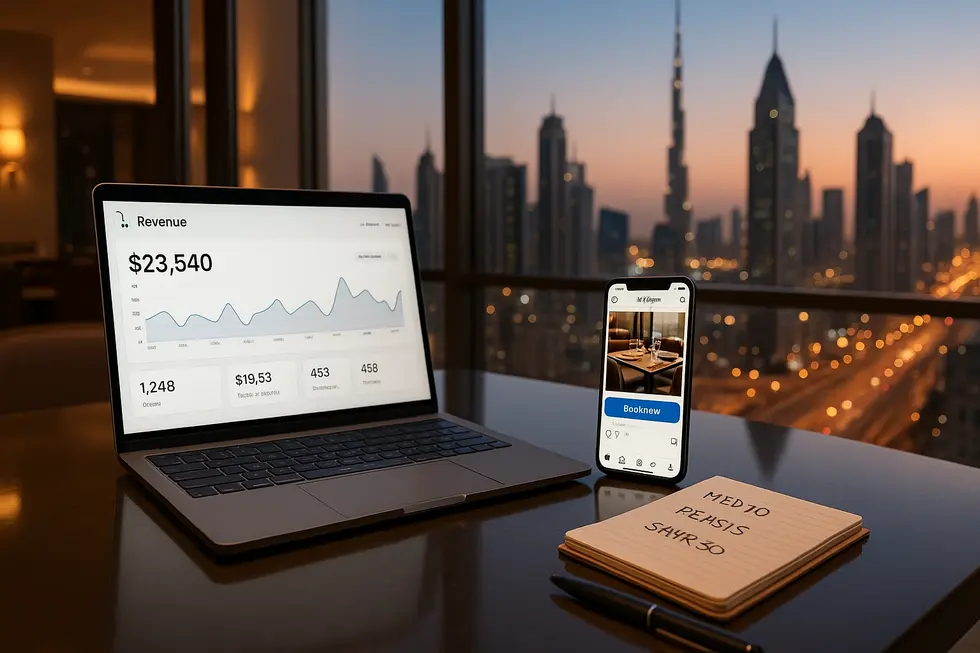 Dubai restaurants must move measurement from vanity to revenue. Social channels remain discovery engines, but ROI now hinges on conversions. Track bookings, sales and walk-ins against campaign costs. Measure cost per booking, revenue per campaign, conversion rate and customer lifetime value. These figures tie content to cash flow and operational goals, such as filling weekday slots or launching a new menu item.
Start by making every social touch actionable. Use UTM parameters, unique promo codes and pixel-based tracking to attribute reservations to posts, reels and influencer content. Embed booking actions directly on profiles and ensure reservation data flows into the restaurant’s central system. That removes data silos and lets managers compare ad spend to actual covers and revenue. Pair these signals with SMS or messaging follow-ups to increase conversion and measure incremental revenue per campaign.
AI and first-party data sharpen where spend goes. Predictive models identify high-intent local users and recommend the creative most likely to drive bookings. Localize messaging in Arabic and test short-form video formats for discovery. Micro-influencers often outperform macros in engagement and cost efficiency, so pilot small partnerships and optimise by cost per booking. Prefer performance-based agreements where fees scale with measurable outcomes.
Operational alignment is critical. Marketing must set clear conversion goals for each campaign. Front-of-house teams should log walk-ins tied to promotions. Reporting dashboards need to show booked covers, incremental foot traffic and repeat visits, not just impressions. Regularly audit attribution rules and reconcile social analytics with POS and reservation logs to avoid inflated success metrics.
Addressing common pitfalls keeps ROI predictable. Avoid over-relying on third-party review data. Guard against fragmented analytics by consolidating ownership of guest profiles and campaign results. Start small: run A/B tests, measure the cost per booking, then scale winning creative and channels. Blend organic community content with targeted paid boosts for reach that converts.
For practical guidance on turning social engagement into measurable reservations, see the platform resource on social engagement into bookings. For an external industry perspective and benchmarks on personalised digital campaigns, consult this research report: https://sevenrooms.com/research/2025-UAE-restaurant-trends/
Final thoughts
Dubai restaurants that measure social media ROI effectively in 2025 will be those that stop counting vanity metrics and start counting revenue, bookings and incremental foot traffic. The practical path is clear: instrument every campaign with unique links or codes, integrate reservations and POS with your CRM, and use AI analytics to find low-cost converters and scale winning creative. Start with small, measurable pilots using micro-influencers and geo-targeted boosts, align marketing with operations to honor demand, and use first-party data to refine offers over time. The result is predictable revenue, lower cost per booking and a social strategy that supports the bottom line rather than just visibility. Let’s turn your menu into your best salesperson – contact us today.
About us
Markus Mensch is a strategic marketing consultancy specializing in hospitality and F&B brands, with offices in Dubai and Germany. Since 2007, the company has supported over 1,000 businesses in increasing visibility, guest loyalty, and revenue – without relying on paid ads. With the proprietary OBC-Strategie®, Markus Mensch and his team provide structured, result-oriented solutions tailored to 4-star hotels and restaurants. The company combines marketing expertise, industry experience, and hands-on implementation to help clients achieve sustainable growth. Made in Germany – Built for Dubai

Markus Mensch
CEO
Transform Your Hospitality Business Today
Are you ready to boost your revenue and enhance guest loyalty? Let's get started!